 how-to
Hiring Professional Movers for Office Relocation: 2026 Guide
Table of Contents
- Start With an Office Moving Timeline, Not a Phone Call
- Build an Office Moving Checklist Before You Contact Anyone
- Where to Find Professional Movers for Office Relocation
- Comparing Office Moving Company Quotes Without Getting Played
- Questions to Ask Office Movers Before You Sign
- Insurance, Contracts, and Move-Day Contingencies
- Frequently Asked Questions
Last Updated: October 9, 2026
Start With an Office Moving Timeline, Not a Phone Call
Most businesses start hiring professional movers for office relocation by calling the first company that shows up in a search. That is backwards.
An office relocation is the coordinated process of moving a business, its furniture, equipment, files and people from one premises to another with minimal disruption to operations. The planning window matters more than the moving company you eventually pick.
Here is the sequence that works.
What to Lock Down 8 to 12 Weeks Out
Confirm the lease dates on both ends, then work backward. You need a floor plan of the new space, a rough headcount per department, and a list of anything unusual (server racks, a commercial kitchen, a lab, a safe).
Book your shortlist of office movers in this window. Good crews fill up, especially at month-end and quarter-end. Send a request for a walkthrough to several companies at once rather than calling one at a time.
The Final Two Weeks and Move Day
Two weeks out, confirm the schedule with your building manager at both locations. Reserve the freight elevator and the loading dock. If the new building has dock access restrictions or a certificate-of-insurance requirement, get that paperwork moving now.
Move day itself should be boring. Label everything by destination room, not by contents. Assign one person per floor to direct traffic. Keep a printed contact list, because your phone will die.
Build an Office Moving Checklist Before You Contact Anyone
A written office moving checklist is what turns a vague request into a quote you can actually compare. Movers price what they can see and measure. Give them nothing, and they will either pad the estimate or lowball it and add charges later.
Your checklist should cover:
- Total square footage and floor count at both locations
- Number of workstations, private offices, and meeting rooms
- Furniture that must be disassembled and reassembled
Photograph everything. A phone full of labelled photos is worth more than a written description when you request a free estimate.
Where to Find Professional Movers for Office Relocation
The best source is a platform that lists local providers by service and city, so you can request several quotes at once instead of dialing one number at a time.
Beyond that, ask your building manager. Property managers see moves every week and know which crews show up on time and which ones damage the elevator.
What matters is getting three or more quotes from licensed and insured companies. One bid is not a market. It is a number someone chose for you.
Comparing Office Moving Company Quotes Without Getting Played
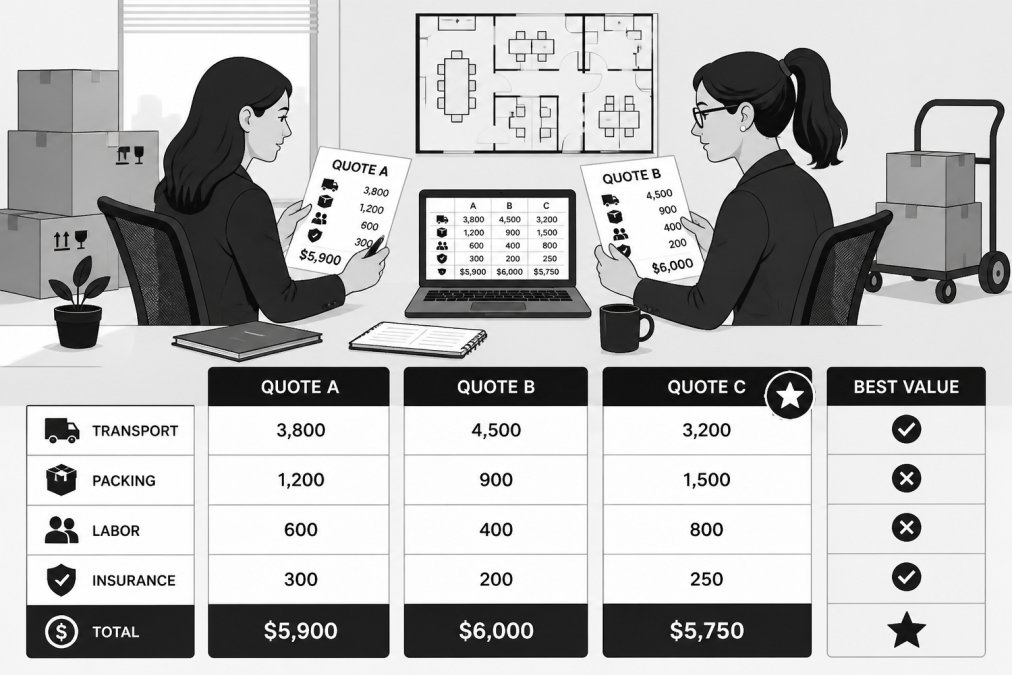
Quotes are only comparable if they cover the same scope. Two bids can look identical on the page and differ by thousands once the truck is loaded, because one priced a dock-level, freight-elevator move and the other priced a walk-up with street parking.
Quote Item | What to Check | Red Flag |
|---|---|---|
Pricing basis | Hourly or flat rate | Rate with no crew size stated |
Crew and truck | Number of movers, truck size | "Crew as needed" |
Disassembly | Included or extra | Silent on furniture |
Packing materials | Supplied or billed separately | No materials line at all |
Insurance | Valuation coverage stated | "Fully covered" with no detail |
Stairs and elevators | Fees for each | Undisclosed access charges |
Overtime | After-hours rate | No stated cutoff time |
Payment terms | Deposit and final invoice | Large deposit, cash only |
Normalize Every Bid to the Same Scope
Before you compare numbers, rewrite each quote into a single scope document. List the same tasks in the same order for every company: number of workstations to disassemble, number of file cabinets to move loaded versus empty, whether the server rack is crated, whether the new space needs furniture reassembly, and the exact access conditions at both buildings.
Then send that scope back to each company and ask them to confirm or revise. A professional operation will adjust the quote in writing. A company that refuses to put the scope in writing is telling you something.
What Actually Drives the Price Up or Down
Distance between the two locations is the obvious one, but it is rarely the biggest. Access is. A building with a loading dock and a freight elevator moves twice as fast as a walk-up with street parking only, and labor is the largest line on most commercial moving invoices.
Find Professional Local Movers →
The cost drivers worth pricing explicitly:
- Labor hours and crew size. Two movers and a small truck versus four movers and a truck of adequate size are different jobs. Ask for the crew size in writing.
- Access conditions. Stairs, long carries, elevator reservations, dock height, and parking permits all add time. A building that requires a certificate of insurance before the truck can enter the dock adds paperwork time, not just labor.
- Packing and materials. Boxes, tape, shrink wrap, mattress-style furniture pads, and custom crates for monitors or servers are usually billed separately. Decide what your team packs and what the movers pack.
How to Read a Lowball Versus a Padded Estimate
When quotes vary wildly, the low one usually left something out. Ask what. Common omissions are materials, stair or elevator fees, overtime, and reassembly.
The honest middle is a quote that lists every line item, states the crew size and truck, names the access conditions it priced, and gives you a written scope you can hold it to. If a company will not itemize, treat the number as a placeholder, not a bid.
Get It in Writing Before You Compare
A verbal estimate is not a quote. Ask for the scope, the crew size, the truck size, the access assumptions, the materials list, the valuation coverage, and the payment schedule in writing. Then compare the documents side by side, not the totals. The company with the clearest written scope is usually the one that will not surprise you on move day.
Questions to Ask Office Movers Before You Sign
The right questions separate a professional operation from a crew with a truck. Ask them before you sign anything, and get the answers in writing.
- Are you licensed and insured, and can you send the certificate?
- Who is my single point of contact on move day?
- Do you use your own employees or subcontractors?
That last one matters more than people expect. A phased move, where one department relocates at a time, keeps the business running. It costs more in coordination, but it protects revenue.
Insurance, Contracts, and Move-Day Contingencies
Standard carrier liability is not the same as full replacement value. Basic coverage typically pays a small amount per kilogram per item, which will not replace a workstation, a monitor, or a server. If your furniture and equipment are worth real money, ask about full-value protection and get the terms in writing before the truck arrives.
Understand the Coverage Types
Moving companies generally offer a few levels of protection, and the names vary by company. What matters is what each one pays when something breaks:
- Released-value or basic carrier liability. The default. Payout is calculated by weight, not by what the item cost. Fine for a box of files, useless for a $2,000 monitor.
- Full-value protection. The mover is liable for the replacement or repair value of the item, usually up to a stated limit. This is what most businesses actually want. Ask whether the limit is per item, per shipment, or per category.
- Third-party or separate cargo insurance. Some companies broker coverage through an insurer rather than carrying it themselves. Ask who the insurer is and how a claim is filed.
Ask for the certificate of insurance and read the limits. A certificate that names your business as an additional insured, or that meets your landlord's requirement, is often a condition of dock access at the new building.
Read the Contract for These Clauses
- Valuation coverage: what is covered, at what limit, and whether it is per item or per shipment
- Exclusions: items the mover will not cover, such as cash, jewelry, perishables, plants, and sometimes electronics packed by the client
- Claims window: how long you have to report damage, and whether it starts on move day or on delivery
Protect High-Value Equipment Yourself
Even with full-value coverage, some items should not ride on the truck. Servers, backup drives, laptops, and anything with client data are better moved by your own team or a specialist IT mover. Photograph the condition of high-value items before loading, keep the photos with the inventory, and note serial numbers on the inventory sheet.
For anything irreplaceable, signed contracts, archived records, specialized lab equipment, move it separately and keep it with you.
Plan Move-Day Contingencies
A backup plan is cheaper than a rescheduled move. Build in these buffers:
- A backup date. Book the move at least three to five days before the lease ends, so a weather delay or a truck breakdown does not put you in breach.
- A backup contact. Get a mobile number for the operations manager, not just the sales contact.
- A printed inventory. Keep one copy with you and one with the crew lead, so nothing is signed off that was not loaded.
For guidance on consumer protections and business contracts, Competition Bureau Canada guidance for businesses and Canadian Consumer Handbook are useful starting points for understanding your rights when hiring a service provider.
Frequently Asked Questions
How do I choose a moving company for an office relocation?
Start by requesting written quotes from at least three commercial movers, each based on the same scope: your floor plan, headcount, furniture list, and equipment inventory. Confirm each company carries cargo insurance and workers' compensation coverage, and ask for references from similar-sized offices moved in the past year. Compare not just the bottom line but what is included, such as packing materials, workstation reassembly, and after-hours scheduling. A local service-provider platform lets you request multiple quotes and compare them side by side instead of calling companies one at a time.
How far in advance should I book office movers?
For a typical office move, start gathering quotes eight to twelve weeks ahead and book your chosen mover at least four to six weeks before move day. Month-end, and the period around the last Friday of any month, fills up fastest, so lock in your date early if you need a weekend or evening slot. If your lease has a fixed end date, work backward from it and build in a buffer week. Booking late limits your choice of movers and often means accepting whatever schedule is left.
What information do office movers need to provide an estimate?
Give every mover the same package: total square footage, number of workstations, a list of large items such as server racks, copiers, and boardroom tables, plus your floor plan for both locations. Note elevator access, loading dock availability, and any building rules on move hours or COIs. Mention anything unusual, like a freight elevator reservation or a tight stairwell. The more accurate your inventory, the fewer surprises appear on the final invoice, and the easier it is to compare quotes fairly.
Can office movers handle computers and other sensitive equipment?
Many commercial movers handle IT equipment, but the safer approach is to separate the physical move from the data risk. Have your IT provider back up and decommission servers, label every cable, and transport drives and backups yourself or with a specialized vendor. Movers can crate monitors, pack workstations, and reinstall furniture, but confirm in writing who disconnects and reconnects equipment. Ask whether the mover carries additional valuation coverage for high-value items, and document serial numbers before move day.