 how-to
7 Signs Your Appliances Need Professional Repair Service
Last Updated: October 24, 2026
Quick Summary
An appliance repair service addresses common failures like refrigerators that won't cool, washing machines that won't drain, dryers that don't heat, and dishwashers that leave dishes dirty. Professional technicians diagnose and fix these problems safely, preventing food spoilage, water damage, and safety hazards while extending appliance lifespan.
- Refrigerators running constantly but not cooling below 10°C often have compressor failure or refrigerant leaks requiring professional diagnosis.
- Washing machines with standing water typically have clogged drain hoses or pump failures that need technician repair.
- Dryers that run but produce no heat usually have broken heating elements, the most common reason for dryer failure.
- Never attempt to repair refrigerants, compressors, or high-voltage components yourself due to certification requirements and serious health risks.
- If repair costs exceed half the price of a new appliance, replacement is usually the smarter financial choice.
Table of Contents
- Common Appliance Problems That Need Professional Attention
- Basic Troubleshooting Before Calling a Technician
- Appliance Maintenance Tips to Prevent Costly Repairs
- Deciding Between Appliance Repair or Replacement
- How to Choose an Appliance Repair Technician
- What to Expect During a Service Visit
- Finding and Booking Local Appliance Repair Services
- Frequently Asked Questions
7 Signs Your Appliances Need Professional Repair Service
When your refrigerator stops cooling or your washing machine floods the laundry room, the question isn't whether you need help, it's how to find the right appliance repair service. Many homeowners wait too long to call a technician, hoping the problem will fix itself. It rarely does. Recognizing the warning signs early can save you money, prevent safety hazards, and extend the lifespan of equipment that costs thousands to replace.
This guide covers the most common appliance failures, what you can troubleshoot safely on your own, and when it's time to book a service call.
Common Appliance Problems That Need Professional Attention
When appliances fail, the impact ripples through your daily routine and your wallet. Recognizing which problems demand immediate professional help is the first step toward avoiding costly damage or safety risks.
Refrigerator repair and freezer issues
A refrigerator that isn't keeping food cold is a food safety emergency. If your fridge runs constantly but doesn't reach the right temperature, the compressor may be failing. If ice builds up inside the freezer or water pools under the crisper drawer, the defrost system could be broken.
Common refrigerator problems include:
- Temperature won't drop below 10°C despite thermostat adjustment
- Ice buildup on coils or inside the freezer compartment
- Water leaking from the bottom or pooling inside
- Compressor running loudly or continuously
- Frost-free cycles not working (ice accumulates instead of melting)
These issues point to compressor failure, refrigerant leaks, or blocked defrost drains. A technician can test the compressor, check refrigerant levels, and clear blockages. Attempting these repairs yourself risks exposure to refrigerant gas, which requires certification to handle safely.
Washing machine and dryer malfunctions
A washing machine that won't drain leaves standing water and wet clothes behind. A dryer that runs but doesn't heat wastes energy and leaves clothes damp. Both problems are common, but the causes differ widely.
Washing machine issues to watch for:
- Water won't drain (clothes stay soaking wet)
- Machine fills but doesn't agitate or spin
- Excessive vibration or loud grinding during the cycle
- Leaking from seals or hoses
- Error codes displayed on the control panel
A clogged drain hose or pump often causes standing water. Motor or transmission failure stops agitation. Bearing wear creates grinding and vibration, and seals degrade over time, especially in high-efficiency machines that use less water and concentrate detergent.
Dryer problems include:
- Drum turns but no heat is produced
- Clothes take multiple cycles to dry
- Lint smell or burning odor during operation
- Drum doesn't turn at all
- Excessive noise from the drum or blower
A broken heating element is the most common reason dryers stop producing heat. A clogged lint filter or exhaust vent restricts airflow, drum rollers wear out and squeal, and thermal fuses blow when the dryer overheats.
Dishwasher, stove, and microwave failures
A dishwasher that leaves dishes dirty or won't drain is frustrating.
Dishwasher signs of trouble:
- Dishes come out dirty despite running a full cycle
- Water won't drain (standing water at the bottom)
- Spray arms don't rotate
- Leaking from the door seal or bottom
- Control panel buttons don't respond
Clogged spray arms or filters prevent water from reaching dishes, a blocked drain hose causes standing water, worn door seals leak, and control board failures require electrical diagnostics.
Stove and oven problems:
- Burners heat inconsistently or not at all
- Oven temperature runs hot or cold despite setting
- Self-cleaning cycle won't start or completes with error codes
- Igniter clicks but doesn't light the burner
- Uneven baking (one side browns faster than the other)
Electric coil burners can be replaced, but if the problem persists across multiple burners, the control board may be faulty. Gas igniter problems require gas-line knowledge, and oven thermostats can drift out of calibration.
Microwave issues:
- Microwave runs but doesn't heat food
- Sparking or arcing inside the chamber
- Door latch broken or loose
- Turntable won't rotate
- Loud humming with no heating action
Sparking indicates metal in the chamber or a damaged waveguide cover. No heat despite running suggests a failed magnetron or high-voltage capacitor.
These are the most common appliance failures that signal you need professional help.
Appliance | Problem | Likely Cause |
|---|---|---|
Refrigerator | Temperature won't drop below 10°C | Compressor failure or refrigerant leak |
Freezer | Ice buildup on coils or inside compartment | Broken defrost system |
Washing machine | Water won't drain, clothes stay soaking wet | Clogged drain hose or pump failure |
Washing machine | Excessive vibration or loud grinding | Bearing wear |
Dryer | Drum turns but no heat is produced | Broken heating element |
Dryer | Clothes take multiple cycles to dry | Clogged lint filter or exhaust vent |
Dishwasher | Dishes come out dirty despite full cycle | Clogged spray arms or filters |
Oven | Temperature runs hot or cold despite setting | Thermostat drift or control board fault |
Basic Troubleshooting Before Calling a Technician
Not every appliance problem requires a service call.
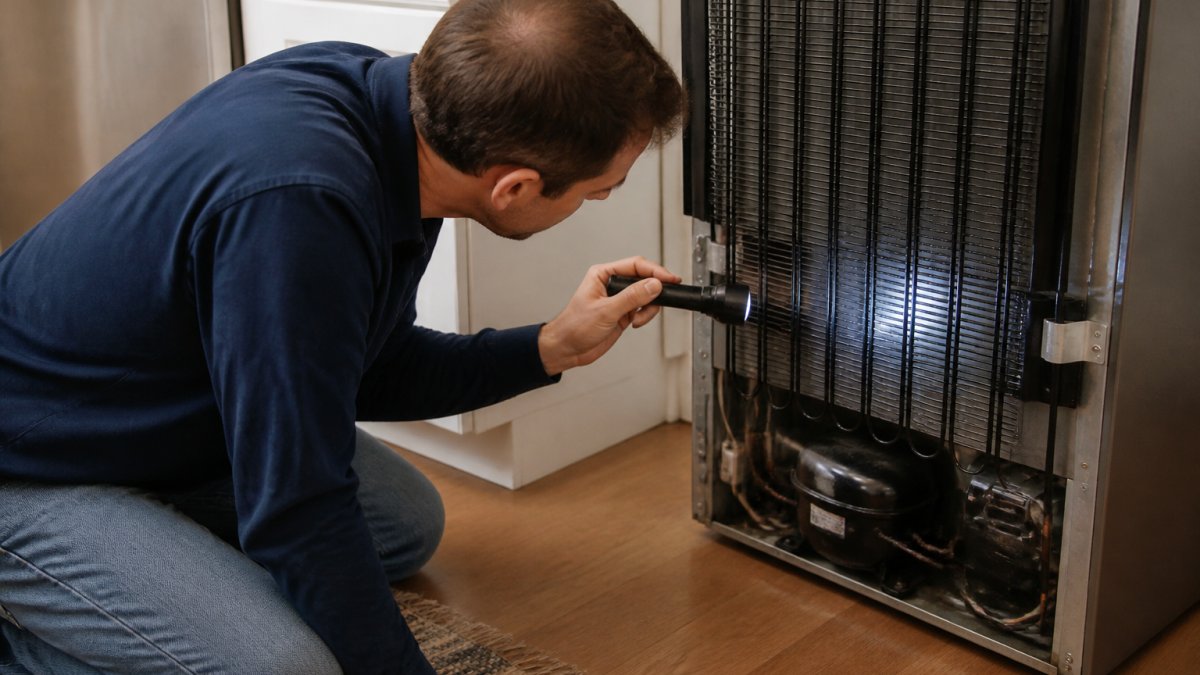
Homeowner using a flashlight to inspect refrigerator coils before calling an appliance repair service
For refrigerators:
Check that the thermostat is set correctly and that food isn't blocking air vents.
For washing machines:
Ensure the lid or door is properly closed and latched. Check that the water supply valves are fully open and that the drain hose isn't kinked or clogged.
For dryers:
Clean the lint trap before every load, since a clogged trap is the top reason dryers dry slowly. Verify the dryer is plugged in and the circuit breaker hasn't tripped.
For dishwashers:
Confirm the door is latched securely. Check the spray arms for blockages and ensure the filter at the bottom of the tub is clean. Make sure the drain hose isn't kinked.
For ovens and stoves:
If a burner won't light, ensure the burner cap is seated and the igniter is dry. For oven temperature issues, check if the self-cleaning lock is engaged. Ensure the oven rack is positioned correctly for even baking.
For microwaves:
Check that nothing metal is inside the chamber, and tighten the screws if the door latch is loose. Ensure the turntable is properly seated.
Watch out: Never attempt to repair refrigerants, compressors, or high-voltage components yourself. These tasks require certification and specialized tools.
Appliance Maintenance Tips to Prevent Costly Repairs
The best repair is the one you never need. Learn the best way to track maintenance so you can stay on top of preventive care and avoid costly breakdowns.
Refrigerators and freezers need annual attention. Vacuum the condenser coils to remove dust buildup, which forces the compressor to work harder. Ensure door seals are clean and creating a tight seal to prevent energy loss.
Washing machines benefit from monthly drain cleaning: run an empty hot-water cycle with two cups of white vinegar to flush out detergent residue and hard water deposits. Inspect inlet hoses yearly and replace them every five to seven years, since the rubber degrades over time. Leaving the door ajar between uses can prevent mold and mildew.
Dryers need more frequent attention than any other appliance. Clean the lint filter after every single use. Periodically check the dryer vent for obstructions to ensure proper airflow, which is crucial for efficiency and safety. Have the exhaust ducting inspected annually for any blockages or damage.
Best practices for tracking and scheduling preventive maintenance help homeowners stay on top of these tasks. Setting calendar reminders ensures you don't skip maintenance cycles that extend appliance life.
Deciding Between Appliance Repair or Replacement
When a technician gives you a repair estimate, you face a critical decision: fix it or replace it? The answer depends on the appliance's age, the repair cost, and how long you plan to keep it.
The age factor matters most. Appliances typically last 10 to 15 years depending on the model and maintenance. If yours is past its expected lifespan, repair costs often approach or exceed the price of a new unit. The repair cost versus replacement rule: if the repair costs more than half the price of a new appliance, replacement is usually smarter. Energy efficiency shifts the calculation, since older appliances consume more electricity and water than new models. Reliability matters too: if your appliance has needed multiple repairs in the past two years, it's showing signs of cascading failures, and replacement avoids the stress of repeated breakdowns.
Ask your technician these questions before deciding:
- What is the remaining expected lifespan of this appliance?
- How likely is this repair to fail again in the next two years?
- What is the total cost of ownership if I repair versus replace?
- Are there efficiency gains with a new model?
How to Choose an Appliance Repair Technician
Not all repair technicians are equal. Some have broad knowledge across multiple appliance brands, others specialize in specific manufacturers, and availability varies widely. When you're ready to book, consider these factors:
Certification and training. Look for manufacturer certifications or relevant credentials, which indicate formal training and ongoing education. Experience with your brand. A technician experienced with your specific brand will diagnose problems faster than someone who works on all brands equally. Transparent pricing. Reputable technicians provide a written estimate before starting work, listing the diagnostic fee, parts cost, and labor charge separately. Warranty on repairs. Ask what warranty covers the repair; most guarantee parts and labor for 30 to 90 days. Availability and response time. If you need same-day or emergency service, ask upfront whether it's offered and what it costs. Customer reviews. Check recent reviews on platforms like Google or the Better Business Bureau and look for patterns. Insurance and licensing. Confirm the technician carries liability insurance and holds a valid business license, as these are important for consumer protection.
What to Expect During a Service Visit
Understanding what happens during a repair visit reduces stress and helps you prepare your home. When the technician arrives, they'll start with a visual inspection and questions about the problem. Tell them exactly what you've observed: when it started, what sounds or smells you've noticed, and what you've already tried. Next, they'll test the appliance with diagnostic tools, which usually takes 30 minutes to an hour. Once they've identified the issue, they'll explain what's wrong and what the repair will cost, and show you the faulty part if possible. If you approve, they'll order parts if needed and schedule a return visit.
Finding and Booking Local Appliance Repair Services
When you need appliance repair service, the challenge is finding a qualified technician quickly. Learn how to find same-day appliance repair in Vancouver and other BC regions to connect with available professionals in your area.
How to find same-day appliance repair options in your region simplifies the search.
MyProBook connects homeowners with local appliance repair professionals across British Columbia. Search for appliance repair service in your area, view technician profiles and customer reviews, and request quotes from multiple providers without making separate phone calls.
Frequently Asked Questions
When should I repair or replace an appliance?
Consider repair if the appliance is less than 8–10 years old, the repair cost is less than 50% of replacement cost, and the malfunction is isolated to one component. If the appliance is nearing the end of its typical lifespan, fails frequently, or the repair approaches replacement cost, replacement is usually more economical. A local appliance repair technician can assess the specific issue and advise whether repair makes sense for your situation.
What should I check before calling an appliance repair technician?
Verify the appliance is plugged in and the circuit breaker hasn't tripped. Check that water inlet valves are open (for washers and dishwashers) and drain lines aren't blocked. Review the user manual for error codes or reset procedures. Note the appliance model and serial number, and describe exactly when the problem started. This information helps the technician diagnose the issue faster and can reduce diagnostic fees.
How can I maintain my refrigerator, washer, and dryer?
For refrigerators: clean coils every six months and ensure door seals are tight. For washers: run a cleaning cycle monthly, leave the door open between uses, and check hoses for cracks. For dryers: clean the lint trap after every load and have ducts inspected annually. Regular appliance maintenance tips like these extend equipment life, improve efficiency, and reduce the need for emergency repairs.
What questions should I ask an appliance repair professional?
Ask about the technician's experience with your appliance brand and model, whether a diagnostic fee applies, what warranty covers the repair and parts, and if same-day or emergency service is available. Request a written estimate before work begins and clarify payment terms. These questions help you evaluate the technician's professionalism and ensure transparent pricing and service expectations.
Appliance failures are stressful, but they're also predictable. Most problems show warning signs weeks or months before complete failure. Catching them early and booking a qualified technician saves money and prevents the emergency of a broken appliance when you need it most. Whether you're troubleshooting a minor issue or scheduling a major repair, understanding your options helps you make the right decision for your home.